How do music teachers develop? Some frameworks to consider

One of the most rewarding and exciting aspects of being involved in music education in higher education is witnessing how preservice teachers can change and develop throughout the course of their undergraduate preparation. In addition to being rewarding, this is one of the many, many aspects of undergraduate teaching that’s extremely compelling.

My colleague, Dr. Margaret Berg from the University of Colorado at Boulder, and I had a co-authored paper recently appear in the Journal of Music Teacher Education that outlines several perspectives when considering ways that music teachers might develop. The specific purpose of our article was to “(a) discuss the value of a research framework and several ways one can conceptualize a framework, (b) briefly present several prominent frameworks for studying teacher development that have been generated in the context of general education, and (c) describe some unique aspects of music teaching and music teaching contexts that could inform theoretical frameworks of preservice music teacher development.”

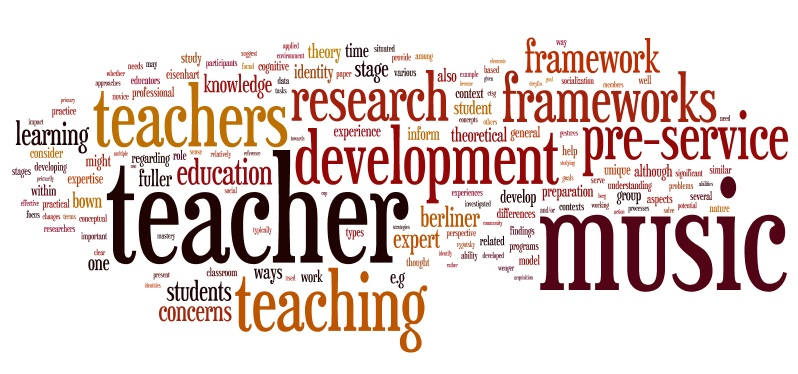
Here is a word cloud of the article’s contents:

JMTE Wordle
Continue reading “How do music teachers develop? Some frameworks to consider”

Obi-Wan your teaching, Episode XXXVII

PRELUDE

What does it mean… to Obi-Wan your teaching?

Definition: To seek wisdom about teaching, to keep a cool head when negotiating good and bad ideas, to have a sense of humor about teaching, to be present when you’re needed (e.g., you may be their only hope), to commit to nurturing the next generation of whatever

Why is this episode thirty seven?

To leave room for prequels (since that’s the way it’s done – obviously)

Episode XXXVII: Listen

Listen to your students like Obi-Wan listens to R2-D2…

    • Be patient and listen very carefully to what your students have to say
    • Even if it’s hard for others to understand, you might be the only one around who can translate what it is they’re trying to say
    • Even when they’re precocious your students can be helpful in ways you can’t imagine
    • Recognize that they’re an integral part of the “team” and “process” when it comes to your teaching

For your listening pleasure…

A link to nothing but R2-D2s sounds

The Future of Music Education: Continuing the Dialogue about Curricular Reform

I’m excited to report the publication of a recent article I wrote for the Music Educators Journal titled: “The future of music education: Continuing the dialogue about curricular reform”

The heart of this article is captured in the opening quote: “The art of progress is to preserve order amid change and to preserve change amid order.” Alfred North Whitehead

In this article I highlight several trends regarding critical arguments that have recently been raised when discussing the secondary large-ensemble tradition in the public schools. In support of secondary school ensembles, I argue for a discussion of curricular reform that avoids polemical rhetoric, straw men, and hasty generalization. I also suggest taking special care when considering the incorporation of new technologies and popular music idioms in music education curricula.

I describe how critical energies might be redirected to what I see as urgent needs for the profession such as:

  • Directing advocacy efforts towards increasing access to music education for underserved populations of children
  • Focusing advocacy efforts towards enhancing support for foundational elementary music experiences
  • Transforming teaching to maximize what’s possible from within the large-ensemble model without needlessly tearing it down by:
    • Increasing the breadth of comprehensive musicianship experiences possible
    • Increasing the degree of individual student empowerment
    • Broadening the range of collaborative approaches to music-making that teach­ers and students could engage in
    • Broadening the inclusiveness of repertoire in large-ensemble curricula

After briefly, yet sincerely, acknowledging the certain need to expand curricular offerings for music in the secondary schools, I close with the following:

“…it will be necessary to cultivate dispositions of patience and reflection with visions of curricular transformation if we hope for significant and lasting changes in the nature and quality of music education for all.”

Please check out the full article here (free to all NAfME members – or email me if you’d like to read it):

Miksza, P. (2013). The future of music education: Continuing the dialogue. Music Educators Journal, 99, 45-50.

Beauty, Motion, and Home – Listening to Music

One of the most exhilarating yet, enigmatic things about teaching, learning and researching music is trying to comprehend the sheer variety of ways that musical experiences can be meaningful to people.

Over the past few months I’ve found myself coming back again and again to three “tunes” that have been part of my listening repertoire for years. I love each of these pieces of music and have found all three to be deep reservoirs of personally meaningful experience. Thinking about “how” and/or “why” each of these tunes might be meaningful is icing on the experiential cake.

Here are some of my experiences and ‘blips’ of potential explanations for how they might arise… …read on into the references if you’re curious for more…

Continue reading “Beauty, Motion, and Home – Listening to Music”

Arts Ed: Reasons to Advocate and Levers to Pull

Reasons to advocate: Inspiring stories

The collegiate chapter of the National Association for Music Education at IU (see their blog!) recently participated in the music advocacy groundswell event (found here) by collecting stories from children about why music matters to them. They made efforts to contact public school teachers in the greater Bloomington area and reached out to the teachers from their hometowns. They ended up collecting nearly 18,000 words worth of inspirational stories of how music has played an essential role in kids’ lives across the country.

The comments the children made are powerful to say the least… they speak of many benefits of music that we, as musicians and teachers, know to be true – finding a place to belong, uncovering a special talent, learning about themselves, developing a means of self-expression, bringing them closer together with friends and family, connecting to a greater community, music as a release and a joy, the acquisition of skills and dispositions that are benefits in other areas of life, etc.

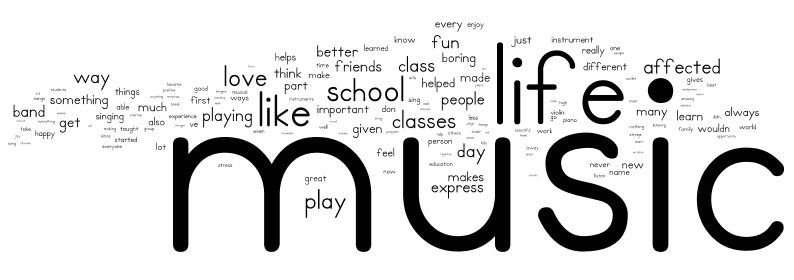
Here is a word cloud from the collection of stories that emphasizes the sentiments the students most commonly expressed – click on it for a close-up:

Better wordle 2

Continue reading “Arts Ed: Reasons to Advocate and Levers to Pull”

I Gave a Final Exam at a Restaurant

Disclaimer: This post is part confessional and part epiphany.

Here’s the context:

I’ve recently made an effort to schedule the work that I require in some of my courses so that the weightiest assignments are not the last assignments. In other words, I’ve been thinking of ways to create a schedule where what might typically be considered a ‘term’ project is due one or two weeks before the traditional final exam week. Then, I schedule a lighter, reflection- and/or application-oriented assignment that’s due during the exam week. I’ve got several reasons for doing this – but, the most obvious are (a) to try to avoid loading the heaviest work on the students in my course during their most busy/stressful/hectic time of the semester and (b) to try to allow for more time during which I can provide substantial feedback on the ‘term’ project for the students to think about/discuss prior to the end of the course.

Here’s how it happened:

We came to the time in the course when folks are scrambling to get their schedules for the last couple of weeks settled and the inevitable queries about time, place, and requirements arose: “Where’s our final exam, what room?” “Which day is it again, when?” “What exactly do we need to turn in?” etc. etc. Once we established the basics – a weekday night, the same space as where we typically have class – I reiterated to the students that the project that was due at our final exam time was relatively ‘light’ as compared to the ‘term’ project they had just completed. I had planned on using the final exam time for this particular course for brief presentations of the students’ final projects (syntheses of materials on a topic of their choosing). Another thought also came to mind, that recently, a colleague of mine had hosted a class event at their house and was very happy with the results. And, after thinking about that…  I simply suggested that we could perhaps hold the final exam event someplace other than the same classroom that we’ve inhabited for the past 16 weeks. As you might have guessed, that seemed to be a somewhat appealing option to everyone (note the sarcastic tone in this font). We decided that everyone would present his or her final work in a quasi-formal manner during dinner and we left it at that.

Here’s what I think:

First off, I must admit that I was skeptical of the idea that an academically rigorous final exam could take place in a social setting such as that typically found in a restaurant. Granted, the assignment in question was not a traditional final exam – but, still, I wanted the students to have high standards and to take their work seriously.

However… once the evening began and the conversation started to flow, I started to think about what might be going on… …I started thinking about important professional social situations I had been in over the past 15 years (meetings with students’ parents, meetings with administrators, meetings with school board members, meetings with new colleagues, interviews, conferences, meetings with donors, etc.)…

We didn’t jump right into the student presentations, there was no ‘start’ or ‘stop’ for the evening and with the exception of a couple of awkward segues put forth by yours truly to move along here and there, the evening was organic.

I was ultimately very pleased with the work the students had done and I think the students were pleased with each others’ work as well. However, what became especially apparent to me was that the students needed to draw upon several skills that I don’t typically see them use, but are quite valuable in academia and professional music education settings in general. In essence, they had to speak intelligently, competently, clearly, and deeply about a topic they were interested in without ‘ripping’ the social fabric of the night. We all had to be able to sit and talk face-to-face about important and valuable ideas while also making small talk, munching on appetizers, ordering entrees, talking with the waiter, and generally getting to know each other as human beings. There was essentially no difference between any of the professional-oriented social situations I described above and this particular “final.” All-in-all, the students presented interesting works, fun was had, and it may even have been an opportunity to ‘practice’ some skills that will come in handy outside of the classroom in the future. I think I might try this again.

…or maybe I’m just rationalizing an evening out a restaurant 😉 As I said in the beginning, this is part confessional, part epiphany – I’d love to hear your thoughts one way or another.

CODA

Recent reading related to this post (albeit tangentially): Plato and a Platypus Walk into a Bar – Cathcart & Klein  (a brilliant book of jokes)

Obi-Wan your teaching, Episode XXXVI

PRELUDE

What does it mean… to Obi-Wan your teaching?

[Verb: I Obi-Wan, You Obi-Wan, She/He Obi-Wans, We Obi-Wan, You (plural) Obi-Wan, They Obi-Wan]

Definition: To seek wisdom about teaching, to keep a cool head when negotiating good and bad ideas, to have a sense of humor about teaching, to be present when you’re needed (e.g., you may be their only hope), to commit to nurturing the next generation of whatever

Why is this episode thirty six?

To leave room for prequels (since that’s the way it’s done – obviously)

Episode XXXVI: Obi-Wan is dead, Long live Obi-Wan

When you’re teaching, be like Obi-Wan when he was a ghost…

    • By that I mean, step back once in a while and recognize your place within a larger force
    • Trust your sense of wisdom and be present with your students when it counts
    • Aim to be the voice your students hear when they most need to trust themselves

When you’re teaching, be like Obi-Wan when he was alive…

    • Be patient and trust in your idea(s) and do everything you can to nurture it(them)
    • If, after trying as hard as you can, it’s ultimately going down the wrong path then chop it up and let it go
    • It’s ok, you can’t lose… …if you try a bad idea and it doesn’t work out you’ve still learned a lot and you’ll win in the end