Research reads to keep you warm on cold winter nights

Because, really, what’s more comforting in the middle of winter than curling up with a great book on quantitative research design and/or statistical analysis!

🙂

This semester I have the pleasure of teaching a course on quantitative research methods for music education. In preparation for this class, I’ve been looking at all kinds of resources that could be helpful for the students (and me) to dig into compelling issues of research design and analysis. A couple of standouts from the pile of books I was wading through are listed below. In addition to being clearly written and approachable in style, each book does a great job elaborating on issues related to quantitative research that are often difficult to digest. These books aren’t designed to be suitable as a text for a music education research methods course, but, they’re certainly excellent supplements.
photo

(snowflake courtesy of Lucy Miksza, 5 yrs old)

Stanovich, K. E. (2001). How to think straight about psychology (6th ed.). Needham Heights, MA: Allyn & Bacon.

  • This book is a terrific, down-to-Earth read about some of the most basic characteristics of scientific inquiry. I particularly enjoy the discussions of scientific inquiry as a converging process, the importance of falsification, and the challenges inherent in probabilistic thinking. Being focused on the social science of psychology, it comes across as a good introduction to issues of scientific activity that comes across in a way that I think is relevant to many of the types of questions that music ed researchers may be interested in.

Abelson, R. (1995). Statistics as principled argument. Hillsdale, NJ: Erlbaum Associates.

  • This is a humorous and plain-spoken collection of wisdom for those who are writing about statistical findings. The first chapter, “making claims with statistics,” raises a host of simple, yet important considerations for stats folk. All of the chapters, though, will be helpful – especially when thinking about developing a writing style.

Jaeger, R. M. (1990). Statistics as a spectators sport. Newbury Park, CA: Sage Publications.

  • I’ve relied on this book for one reason or another many times since getting bitten by the music ed research bug. This book lays out basic and intermediate statistical topics in an easy-to-grasp, conceptual manner. Jaeger’s explanations could be a great help for those who find that math and formulas seem to get in the way of understanding how statistical analysis techniques could serve music ed researchers. Or, if you’re looking for a book that ties together some loose ends and fills conceptual gaps – this could really help.
Experimenting with efficient practice: Plan-Perform-Reflect

I’m happy to be reporting on a recent study that I’ve had published in the journal, Psychology of Music:

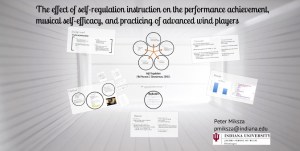
The Effect of Self-Regulation Instruction on the Performance Achievement, Musical Self-efficacy, and Practicing of Advanced Wind Players

In essence, the study was designed to assess the relative benefits of (1) instruction for practicing that included explanations and demonstrations of self-regulated approaches to learning such as planning, goal-setting, self-evaluation, strategy use, and reflection as compared to (2) instruction that dealt with explanations and demonstrations of strategies use only. The study employed an experimental design with pre- and post-test measures of each outcome and randomized assignment of individuals to treatment and control groups. The participants for the study were undergraduate brass and woodwind players. They were asked to watch contrasting video demonstrations of practice approaches across 5 days. Ultimately, the results indicate a promising, positive effect of the self-regulation training.

If you’re interested in learning more about the work and seeing the video used for the experimental instruction… …check out this Prezi with narration in the pic below:

Practice Prezi Shot copy

Ed Policy and Music Teacher Preparation

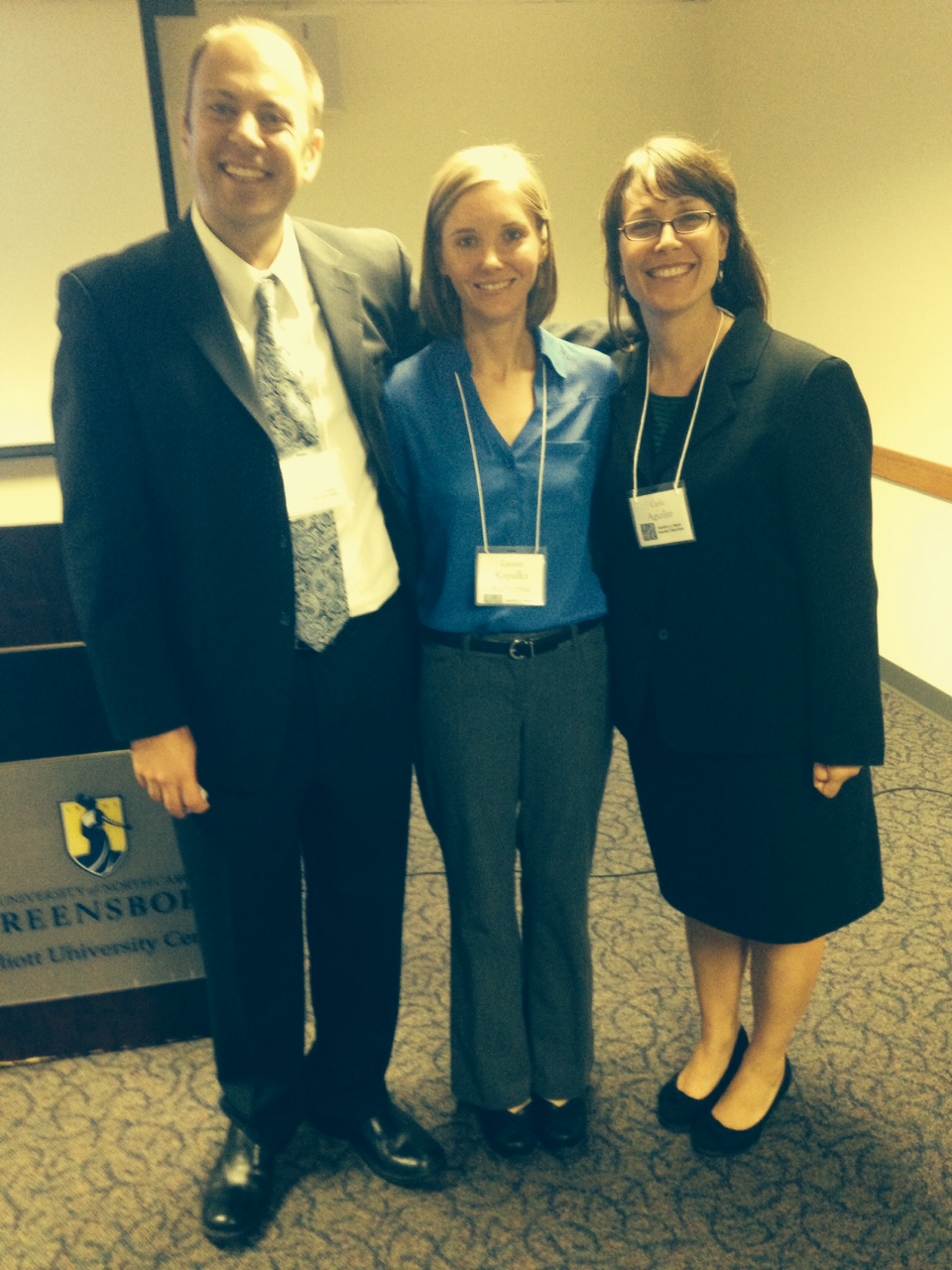
This weekend I had the opportunity of co-presenting a session on embedding educational policy issues in music teacher preparation coursework at the bi-annual Symposium on Music Teacher Education in North Carolina. It was a pleasure to work with our newest Jacobs School of Music music education colleague, Dr. Lauren Kapalka-Richerme and IU JSOM alumna, Dr. Carla Aguilar who is currently coordinator of music education at Metropolitan State University in Denver, Colorado.

This is us enjoying the day! And here is a link to our presentation slides: Aguilar, Miksza, Richerme – Policy – SMTE – 2013.

Also, check out the SMTE Policy ASPA Facebook page here: SMTE POLICY

photo

Continue reading “Ed Policy and Music Teacher Preparation”

Theoretipracticaliexpealidocious

Preface

This post includes a few brief, light-hearted thoughts I put out to the music education graduate research colloquium today during our faculty roundtable on the theme of, “Intersections Between Research and Practice.” This event was intended to be an introductory colloquium during which the faculty shared 5- to 7-minute reflections on how they see their own research impacting their practical concerns. If you’re curious, this was my take…

Continue reading “Theoretipracticaliexpealidocious”

Near, Far, and In-between – Some views on instrumental music teaching effectiveness*

The summer course I’m teaching, Advanced Instrumental Methods, has kicked off this month and I thought I’d share a bit about the first topic we tackled. We began with an exploration of what it means to lead as an instrumental music educator and what factors seem to contribute to teaching effectiveness in instrumental music settings. As the title of this post implies, we tried to consider several perspectives – near, far, and in-between – to paint a picture of great instrumental music teaching.

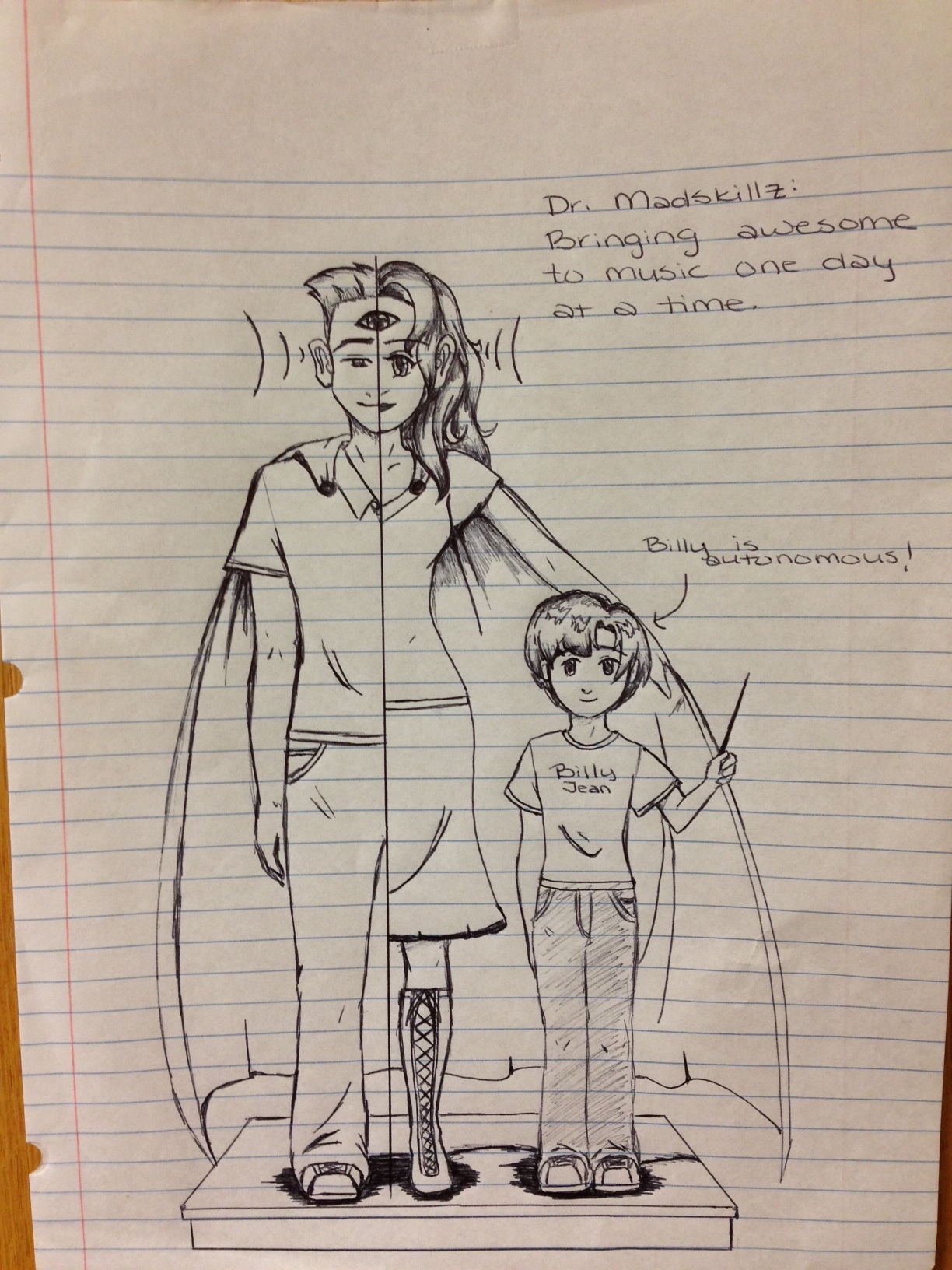
One of the more entertaining discussion activities we tried in class was to draw a comic book superhero depicting what an ideal conductor might look like and trying to exemplify what kinds of superpowers a super-instrumental music teacher might have – here’s one image from some particularly gifted artists in class… see if you can guess the attributes they were trying to emphasize… Notice some of the more unique elements… the “third eye,” “lack of gender-specificity,” “inclusion of a student (with their own baton),” etc.

Dr. Madskillz

Here’s a quick glimpse of some of the perspectives we’ve brought to the issue as we zoom in and out in our discussions…

Continue reading “Near, Far, and In-between – Some views on instrumental music teaching effectiveness*”

How do music teachers develop? Some frameworks to consider

One of the most rewarding and exciting aspects of being involved in music education in higher education is witnessing how preservice teachers can change and develop throughout the course of their undergraduate preparation. In addition to being rewarding, this is one of the many, many aspects of undergraduate teaching that’s extremely compelling.

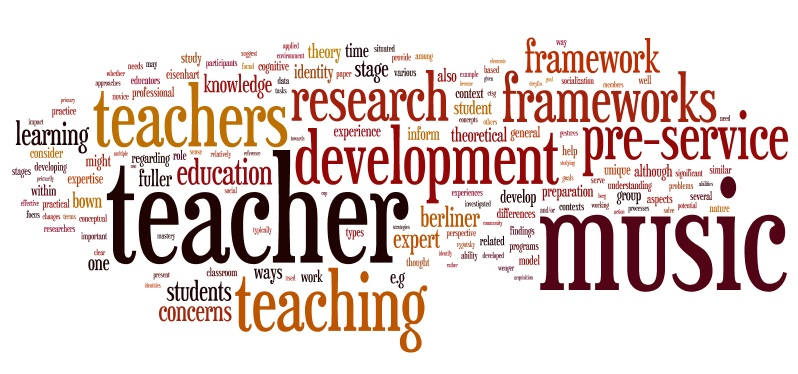
My colleague, Dr. Margaret Berg from the University of Colorado at Boulder, and I had a co-authored paper recently appear in the Journal of Music Teacher Education that outlines several perspectives when considering ways that music teachers might develop. The specific purpose of our article was to “(a) discuss the value of a research framework and several ways one can conceptualize a framework, (b) briefly present several prominent frameworks for studying teacher development that have been generated in the context of general education, and (c) describe some unique aspects of music teaching and music teaching contexts that could inform theoretical frameworks of preservice music teacher development.”

Here is a word cloud of the article’s contents:

JMTE Wordle
Continue reading “How do music teachers develop? Some frameworks to consider”

“Believe Me, There’s Nothing Boring About Statistics”

This is a terrific BBC documentary on stats – for those of you that enjoy the insights that statistical analyses can yield, check it out. I realize this has probably made the internet rounds a few times over, but it’s too good not to share…

Watch the video “The Joy of Stats” at the Gapminder website.

Also – the Gapminder website is generally amazing. Playing with the map is great fun.

It’s fun to imagine the ways such approaches to data analysis and visualization could enhance what we know about music education in the world.


Beauty, Motion, and Home – Listening to Music

One of the most exhilarating yet, enigmatic things about teaching, learning and researching music is trying to comprehend the sheer variety of ways that musical experiences can be meaningful to people.

Over the past few months I’ve found myself coming back again and again to three “tunes” that have been part of my listening repertoire for years. I love each of these pieces of music and have found all three to be deep reservoirs of personally meaningful experience. Thinking about “how” and/or “why” each of these tunes might be meaningful is icing on the experiential cake.

Here are some of my experiences and ‘blips’ of potential explanations for how they might arise… …read on into the references if you’re curious for more…

Continue reading “Beauty, Motion, and Home – Listening to Music”

Arts Ed: Reasons to Advocate and Levers to Pull

Reasons to advocate: Inspiring stories

The collegiate chapter of the National Association for Music Education at IU (see their blog!) recently participated in the music advocacy groundswell event (found here) by collecting stories from children about why music matters to them. They made efforts to contact public school teachers in the greater Bloomington area and reached out to the teachers from their hometowns. They ended up collecting nearly 18,000 words worth of inspirational stories of how music has played an essential role in kids’ lives across the country.

The comments the children made are powerful to say the least… they speak of many benefits of music that we, as musicians and teachers, know to be true – finding a place to belong, uncovering a special talent, learning about themselves, developing a means of self-expression, bringing them closer together with friends and family, connecting to a greater community, music as a release and a joy, the acquisition of skills and dispositions that are benefits in other areas of life, etc.

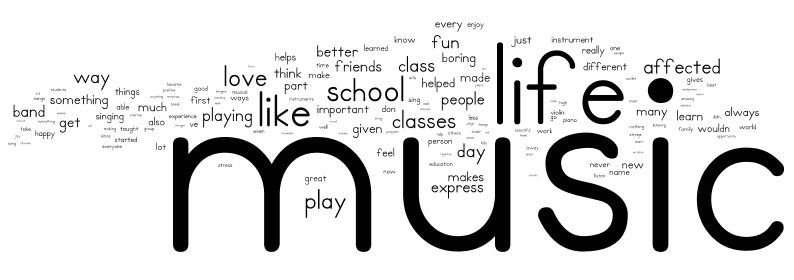
Here is a word cloud from the collection of stories that emphasizes the sentiments the students most commonly expressed – click on it for a close-up:

Better wordle 2

Continue reading “Arts Ed: Reasons to Advocate and Levers to Pull”

Music Education: Snowballs, ice sculptures, and ice sculptures of snowballs

This a playful metaphorical reflection on what seem to be fairly periodic fluctuations in my thoughts on what it means to be building a career in academia as I’ve moved from being a graduate student to someone about to apply for tenure.

Maybe sometime you feel similarly about what you do?

Continue reading “Music Education: Snowballs, ice sculptures, and ice sculptures of snowballs”